

Introduction
In many Indian families, investments made decades ago are often discovered only after the death of a family member. These investments may include a physical share certificate issued by companies before the demat era. Unfortunately, many heirs face problems because of lost of share certificate situations where the original documents are missing, damaged, or misplaced.
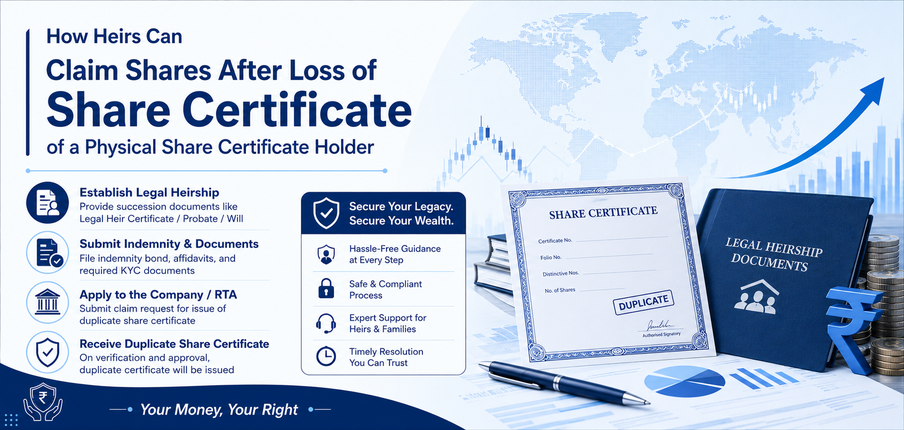
When a physical share certificate holder passes away, legal heirs need to follow a proper procedure to claim ownership of shares. If there is a lost of share certificate issue, the process becomes more complicated because companies require proof before issuing a duplicate share certificate.
This blog explains the complete process heirs must follow after lost of share certificate cases, how to apply for a duplicate share certificate, and how to transfer ownership from a physical share certificate holder to legal heirs.
Understanding a Physical Share Certificate
A physical share certificate is a paper document issued by a company that proves ownership of shares. Before electronic demat accounts became common, investors used to hold shares in physical form.
A physical share certificate generally contains:
- Shareholder name
- Folio number
- Certificate number
- Number of shares
- Company details
Today, many families still hold investments in the form of a physical share certificate. However, due to poor storage or lack of awareness, many cases involve lost of share certificate complications.
What is Lost of Share Certificate?
Lost of share certificate refers to situations where the original share certificate cannot be found due to:
- Misplacement
- Theft
- Fire damage
- Water damage
- Natural disasters
- Poor document storage
When there is a lost of share certificate issue, heirs cannot directly transfer shares without obtaining a duplicate share certificate.
The company must first verify ownership before issuing a duplicate share certificate to the rightful claimant.
Challenges Faced by Heirs in Lost of Share Certificate Cases
Heirs often face multiple difficulties while handling lost of share certificate matters.
Common Challenges Include
- Lack of knowledge about investments
- Missing folio details
- No nomination available
- Multiple legal heirs
- Signature mismatch
- Old address records
- Difficulty obtaining legal documents
In most cases, obtaining a duplicate share certificate becomes the first major step before shares can be transferred.
Importance of a Duplicate Share Certificate
A duplicate share certificate is issued by the company when the original share certificate is lost, damaged, or destroyed.
Without a duplicate share certificate, heirs cannot:
- Transfer ownership
- Convert shares into demat form
- Sell shares
- Claim dividends
- Transfer shares to IEPF
The duplicate share certificate acts as a replacement for the original document.
Legal Process After Lost of Share Certificate of a Physical Share Certificate Holder
The process depends on whether the deceased shareholder had a nominee registered or not.
Case 1: Nominee Registered
If a nominee exists, the process becomes simpler. The nominee can apply for:
- Duplicate share certificate
- Transmission of shares
- Demat conversion
Even in nominee cases involving lost of share certificate, companies still require proper verification.
Case 2: No Nominee Registered
If no nominee exists, legal heirs must submit:
- Succession certificate
- Probate of will
- Letter of administration
- Legal heir certificate
After verification, the company may issue a duplicate share certificate.
Step by Step Process to Claim Shares After Lost of Share Certificate
Step 1: Identify Shareholding Details
The first step in a lost of share certificate case is identifying:
- Company name
- Folio number
- Number of shares
- Shareholder details
This information may be available through:
- Old dividend warrants
- Bank statements
- Income tax records
- Registrar and transfer agents
Once details are identified, heirs can proceed for duplicate share certificate application.
Step 2: Inform the Company About Lost of Share Certificate
The company or registrar must immediately be informed about the lost of share certificate.
The request should include:
- Shareholder name
- Folio number
- Certificate details if available
- Circumstances of loss
The company may place a stop transfer instruction on the shares to prevent fraud.
Step 3: File FIR or Police Complaint
In most lost of share certificate cases, companies ask for:
- FIR copy
- Police complaint
- Non traceable report
This acts as proof that the physical share certificate is genuinely lost.
Step 4: Submit Affidavit and Indemnity Bond
For issuing a duplicate share certificate, companies generally require:
- Affidavit for lost of share certificate
- Indemnity bond
- Identity proof
- Address proof
These documents protect the company from future disputes.
Step 5: Newspaper Advertisement
In some cases involving high value shares, companies may ask heirs to publish a newspaper advertisement regarding the lost of share certificate.
This allows any third party objections before issuing a duplicate share certificate.
Step 6: Verification by Company
The company verifies:
- Shareholding records
- Legal heir documents
- Identity documents
- Signature details
Once verification is complete, the company issues a duplicate share certificate.
Step 7: Transmission of Shares
After receiving the duplicate share certificate, heirs can apply for transmission of shares into their name.
Transmission means transfer of ownership due to death of the original physical share certificate holder.
Step 8: Convert Physical Share Certificate into Demat Form
Today, companies encourage heirs to convert physical share certificate holdings into demat format.
Benefits include:
- Better security
- Easier transfer
- Faster transactions
- Reduced risk of lost of share certificate issues in future
Documents Required in Lost of Share Certificate Cases
Basic Documents Required
- Death certificate of shareholder
- PAN card
- Aadhaar card
- Address proof
- Passport size photographs
- Affidavit for lost of share certificate
- Indemnity bond
- FIR copy
- Legal heir proof
For duplicate share certificate issuance, companies may ask for additional documents depending on the case.
Importance of Legal Heir Documents
When no nominee exists, legal heir documents become extremely important in lost of share certificate matters.
Common Legal Documents Include
- Succession certificate
- Probate of will
- Legal heir certificate
- No objection certificate from other heirs
These documents help establish rightful ownership before issuing a duplicate share certificate.
Common Reasons for Rejection of Duplicate Share Certificate Requests
Many applications for duplicate share certificate get delayed or rejected because of mistakes.
Common Reasons Include
- Incomplete documents
- Incorrect folio details
- Signature mismatch
- Missing FIR copy
- Unclear legal heir documents
- Wrong affidavit format
Proper preparation helps avoid rejection in lost of share certificate cases.
How Long Does the Process Take?
The timeline for obtaining a duplicate share certificate depends on:
- Company procedures
- Completeness of documents
- Legal heir disputes
- Value of shares
Simple cases may take a few weeks, while complex lost of share certificate matters may take several months.
Importance of Professional Assistance
Many heirs are unfamiliar with legal and procedural requirements involved in lost of share certificate matters.
Professional consultants help with:
- Document preparation
- Legal heir verification
- Communication with company
- Duplicate share certificate application
- Demat conversion
This reduces delays and improves the chances of successful claim approval.
Risks of Ignoring Old Physical Share Certificate Investments
Many families ignore old investments because they believe recovery is impossible after lost of share certificate issues.
However, ignoring these shares can result in:
- Transfer to IEPF
- Loss of dividends
- Legal complications
- Delayed ownership transfer
Timely action helps heirs recover investments smoothly.
Tips for Heirs Handling Lost of Share Certificate Cases
Important Tips
- Keep all old financial records safely
- Search for dividend documents
- Contact registrar and transfer agents
- Verify nominee status
- Prepare legal heir documents properly
- Apply for duplicate share certificate quickly
These steps help heirs avoid future complications related to physical share certificate ownership.
Difference Between Transmission and Transfer
Many people confuse transmission with transfer in physical share certificate matters.
Transmission
Transmission happens after death of a shareholder and involves legal heirs.
Transfer
Transfer occurs when shares are sold or gifted during the shareholder’s lifetime.
In lost of share certificate situations after death, heirs usually apply for transmission after obtaining a duplicate share certificate.
Role of Registrar and Transfer Agent
The registrar and transfer agent plays an important role in handling lost of share certificate matters.
Their responsibilities include:
- Verifying shareholder records
- Processing duplicate share certificate requests
- Handling transmission applications
- Updating company records
Heirs must coordinate closely with the registrar during the process.
Why Dematerialization is Important
A physical share certificate carries risks such as:
- Theft
- Damage
- Misplacement
- Forgery
Converting a physical share certificate into demat form helps avoid future lost of share certificate problems.
Demat shares are safer and easier to manage.
Conclusion
Handling investments after the death of a family member can be emotionally and legally challenging, especially in cases involving lost of share certificate issues. When the original physical share certificate is missing, heirs must follow a structured legal process to establish ownership and obtain a duplicate share certificate.
Although the process may seem complicated, proper documentation, timely action, and professional guidance can help heirs successfully recover and transfer shares. Understanding the procedures related to physical share certificate holdings ensures that valuable family investments are not permanently lost.
If your family is dealing with a lost of share certificate issue, taking immediate action for duplicate share certificate issuance and transmission of shares is the best way to secure ownership and protect future financial interests.