


The transmission of shares is an essential legal process that ensures the rightful transfer of shares from a deceased shareholder to their heirs, nominees, or legal successors. Whether it’s the transfer of shares after the death of a shareholder, recovering assets transferred to the Investor Education and Protection Fund (IEPF), or managing intricate procedures, the process can often be challenging without professional guidance.
At Asset Retrieval Advisors, we specialize in simplifying the transmission of shares process, providing expert support for resolving issues related to shares transfer to IEPF, and ensuring rightful claimants receive their due without undue stress.
This comprehensive guide delves into every aspect of IEPF share transfer, transmission of shares, and the procedural requirements involved.
Understanding Transmission of Shares
Transmission of shares refers to the process by which ownership of a deceased shareholder’s shares is legally transferred to their heirs or nominees. Unlike the voluntary transfer of shares, transmission occurs due to inevitable circumstances like death, insolvency, or incapacity of the original shareholder.
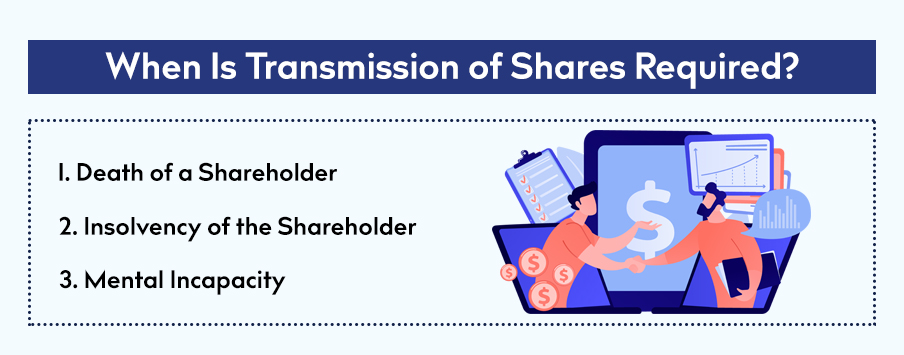
When Is Transmission of Shares Required?
1. Death of a Shareholder:
When a shareholder passes away, their shares need to be transmitted to the legal heir or nominee.
2. Insolvency of the Shareholder:
Shares may be transmitted to the official receiver or trustee in case of insolvency.
3. Mental Incapacity:
If a shareholder is declared mentally incapacitated, shares may be transmitted to a legally appointed guardian.
Lorem ipsum dolor sit amet, consectetur adipiscing elit, sed do eiusmod tempor incididunt ut labore et dolore magna aliqua. Ut enim ad minim veniam, quis nostrud exercitation ullamco laboris nisi ut aliquip ex ea commodo consequat aute irure dolor in reprehenderit.
Key Documents Required for Transmission of Shares
Key Documents Required for Transmission of Shares
- Certified copy of the death certificate.
- Succession certificate or probate of the will.
- PAN card and address proof of the claimant.
- Transmission request form issued by the company or registrar.
- Original share certificates (for physical shares).
- Nomination registration proof (if applicable).
The Importance of Timely Transmission of Shares
Ensuring a timely transmission of shares is vital for:
- 1. Safeguarding Shareholder Rights:
- Legal heirs gain access to dividends, voting rights, and other shareholder benefits.
- 2. Avoiding IEPF Transfer:
- If shares or dividends remain unclaimed for seven years, they are transferred to the IEPF.
- 3. Simplifying Estate Management:
- Proper transmission reduces disputes and ensures seamless estate planning.
IEPF Share Transfer: What You Need to Know
What is IEPF Share Transfer?
When shares and dividends remain unclaimed for seven consecutive years, they are transferred to the Investor Education and Protection Fund (IEPF). The IEPF was established by the Government of India to protect investor interests.
- 1. File a claim with the IEPF Authority using Form IEPF-5.
- 2. Submit required documents, including legal proofs and shareholder details.
- 3. Coordinate with the company for verification.
- 4. Receive approval from the IEPF Authority and reclaim your shares.
Steps in the Transmission of Shares Process
1. Notify the Issuing Company or RTA
- Inform the company or registrar (RTA) about the death of the shareholder.
- Provide details such as folio number, shareholder name, and type of shares.
2. Gather and Submit Documents
Ensure that all required legal and procedural documents are in order, including:
- Certified death certificate.
- Legal heir certificate or will probate.
- Transmission request form.
3. Verification and Processing
- The company or registrar verifies the documents submitted.
- In case of physical shares, new certificates are issued.
- For demat shares, ownership is transferred electronically to the heir’s demat account.
4. Special Cases: IEPF Recovery
- If shares are already transferred to the IEPF, additional recovery steps must be initiated.
- Filing claims with the IEPF Authority and coordinating with the company is essential.
Dematerialized vs. Physical Shares: Key Differences in Transmission
| Aspect | Dematerialized Shares | Physical Shares |
| Form | Held in electronic format. | Held as physical certificates. |
| Process | Transferred to the heir’s demat account. | Requires issuance of new certificates. |
| Documentation | Minimal paperwork. | Extensive paperwork and legal proofs required. |

Challenges in Transmission of Shares
- 1. Unregistered Nominations:
- When no nominee is registered, legal heirs must secure succession certificates or court orders, complicating the process.
- 2. IEPF Share Transfers:
- Recovering shares transferred to the IEPF involves lengthy documentation and approvals.
- 3. Outdated Records:
- Physical shares with missing or outdated records create additional hurdles.
How Asset Retrieval Advisors Can Help
At Asset Retrieval Advisors, we offer a comprehensive suite of services to address every challenge in the transmission of shares process, including:
1. Professional Documentation Assistance
We handle all paperwork, from drafting affidavits to preparing claim forms, ensuring accuracy and compliance.
2. Expert Guidance for IEPF Recovery
Our team simplifies the recovery of shares transferred to the IEPF by navigating the regulatory landscape.
3. Seamless Liaison with Companies
We coordinate with issuing companies and registrars, minimizing delays and ensuring a hassle-free process.
4. Legal and Procedural Expertise
Whether it’s obtaining a succession certificate or resolving disputes, we provide end-to-end support.
Frequently Asked Questions (FAQs)
Transmission occurs due to death or incapacity, while transfer is a voluntary act involving consideration.
Unclaimed shares are transferred to the IEPF, but they can be recovered through a structured claim process.
For cases with a registered nominee, a succession certificate may not be required. Otherwise, legal proof is mandatory.
Call to Action
Secure Your Rightful Shares Today!
Don’t let procedural complexities delay your claim. Contact Asset Retrieval Advisors for expert guidance on transmission of shares, recovering assets from the IEPF, and more.
Call us at [+919810794633] or fill out our Enquiry Form to get started now.
By choosing Asset Retrieval Advisors, you gain a trusted partner committed to safeguarding your financial interests and ensuring a smooth transmission of shares process. Reach out to us today for professional assistance!